Wednesday, July 24, 2019

Day 3: Teacher-to-teacher connections

Today in emojis: 🍎↔️🍎

This morning I went for a walk around the pool area a bit just to move after breakfast.  It was here I realized I picked the wrong place to life guard in high school.  Check out this lifeguard in a yellow shirt.  Yeah, he's skimming leafs out of the pool, just like I had to do, but those surroundings are FABULOUS.


After breakfast, we went to visit Jambalaya University, which is a private Catholic university in Jakarta.  There we met with about 30 English teachers from the Jakarta region.

There was a group photo taken.  This is a picture of me being yelled at to get into the group photo.  I hope to replace this with the group photo soon, but right now, this is the best I've got!

Nicki, from our group was chosen to speak to the group on the educational system in the US.  She did a great job given the variety of school environments there are in the US.  We also heard from two teachers from Indonesia and then spoke in small groups to share about our contexts.  It was loud.  Imagine 50 teacher-voices in one room.  LOUD.

What struck me was there were a lot of similar pain points and passion points in the room.  From both sides, teachers were frustrated with the requirements from the "higher-ups" that interfered with the job of teaching.  We all felt like teaching was hard but very rewarding.  We had a common language, but that language didn't mean the same thing - what it meant to "lesson plan" looked different in different groups and what it meant to have "student centered instruction" looked different too.

It is important to note though that how these definitions varied was not just between Indonesians and Americans, but between Americans too.  In some ways it seems almost premature to talk about these things without fully understanding the context of the American teachers around me.  One American teacher talked about how she has a 2 hour break every day and class sizes no larger than 25... AHEM... that is NOT what my reality looks like in my classroom.  The phrase of the day was "varies by location".  Everything, varies by location in the US. In some ways, the most valuable part of being in Indonesia is being able to talk to other teachers in the US.  It seems crazy to me that we needed to fly 31 hours to do that, but it shows how few opportunities there are for teachers to collaborate in the US locally or nationally.

I often got frustrated in my school when the district would insist that we needed to have identical exams between the two high schools.  When you look between districts, we don't have identical exams, or even content.  When you zoom out to the nation level, the differences are even more severe in the US.

When talking to the Indonesian teachers, they talked a lot about character development and how that was reflected in student grades.  I am excited to look at that more too.  A friend of mine in this same program went to India where they had a "happiness" curriculum to combat the stress students faced.  It is hard to tell if these "socio-emotional skills" are something that we in the US are overlooking or if they are something we have overcome.   At this point, I would argue for "overlooking".  I do recognize that what "good behavior" looks like in the US is very tied to culture and when we reward behaviors, we are perpetuating a system that is mostly based in white-privilege.  But even that is something we could dive into more as teachers (and as a society) in the US.

Also in the univeristy I talked to the woman who seemed to be in charge of the program.  She mentioned that Indonesian teachers think US teachers are like what they see in the movies.  She said that she tries to say that really US teachers are more complex than anything in Hollywood.  Again, I feel like this is an issue we see in the US too.  To many people, in the US even, every teacher is either that dude from AP Bio or the woman from Freedom Writers.  I am thankful of the work Knowles is doing to change that narrative around the work teachers do.  And it is a good reminder I need to write an article for them soon! (Adding that to my to do list for when I get back...)

After the exchange we took a tour of the school where we stumbled upon a performance in the commons.  I suppose that is another similarity between Indonesia and the US - college campuses always have something going on.


Apparently this was a dance from the Ache part of Indonesia which is a more conservative Muslim area of the country.   I think the name of the dance was Saman, but I am not certain about that.

From there, we headed to the US embassy.  I had never been inside a US embassy before.  But as you can imagine, it was pretty secure.  No phones inside were allowed.  They had an "American Corner" which was an area open to the public (as long as they arranged a time 24 hours in advance) with a 3D printer, some maker materials, some American games (my favorite was a Democrats vs Republicans Stratego game), and some US books/magazines.  We stayed in this area for a series of presentations from security and medical folks and other people associated with various programs.

No cameras allowed inside the embassy, but here's a picture from outside.  


One thing I found interesting was that most of the US positions move every 2-3 years so they really rely on the local staff to carry on the institutional knowledge of the place.  I asked them how new administrations affect the day-to-day work and they said much of the actual work is the same, but


  • If you get thrown into a jail in Indonesia someone will come and visit you every 3 months to make sure you are OK. 
  • There are only 4 languages that the state department takes more than a year to learn... Chinese, Korean, Arabic, and.. cannot remember the last one.
    • Everything else takes less than a year - but still 5 hours of class time each day (immersive) and homework
  • One of the officials was previously in Kyrgystan.  He talked about how in Kyrgystan he did more adoptions than in Indonesia which I thought was interesting.  Most of his work here is for visas. 
After that we headed back to the hotel where I am currently writing this blog post.  I am about to go out to the pool and do a bit of reading to relax/re-center.  I have been waking up at 4:45 AM most days here which seems to correspond to the morning prayer (perhaps this is not coincidental).  But I kinda love it.  It gives me a chance to go to the gym before breakfast.  BTW... breakfast here is amazing.  I will take a picture of my plate tomorrow, but let's just say I am usually super psyched about made-to-order omelettes (which this place has), but that's not the best part of this breakfast.  This place has breakfast sushi!!!

Breakfast sushi.


Tuesday, July 23, 2019

Day 2: Educational Crash Course

Day in emojis: 👩‍🏫🚐

Today we started with a lesson on the Indonesian education system.  There were a few big surprises to me:

  • They have a lot of "school" days - they don't have much a summer break at all, but at the same time there are a lot of school days dedicated non-academic things.  They have days where everyone cleans the school, days where they have community events, and days they have celebrations.  
  • They go to school on Saturdays.  It sounds like this is starting to change, and they are moving to longer M-F school days and getting rid of Saturdays.  Before, elementary school essentially got done at noon every day.
  • There are lots of uniforms.  Each grade level has their own national uniform and even the teachers wear government uniforms Monday and Tuesday, Wednesday is a white uniform, Thursdays everyone wears Batik (a local dress), and Fridays are... something else, I cannot remember.  
  • Islamic studies is taught in nearly every grade level.  There are Islamic High Schools that are part of the educational system here where they do a lot more of the Islamic Study coursework, but even the average public school has Islamic study.
  • Special Ed isn't as much of a thing here.  Their supports for special ed students appear to be rather minimal.
  • Students need to test at the end of each band of education (elementary, middle, and high school).  It sounds like if students don't pass there isn't a whole lot of repercussions to their educational career - they can move on to the next level.  I am guessing that if they don't pass the high school exam, their chances of going to college are quite low.
All of that was kind of an "information dump", but I think once we get to our actual schools we will understand this system a bit better.  I will be in a Vocational school which is a parallel track to the traditional high school track.

After this, we went to the offices of a program that arranges US/Indonesian partnerships.  They told us about some of their programs they have which were really impressive. 

A group photo from the office.


From there, we headed to the National Monument.  We went inside and saw the museum there too. 


Monday, July 22, 2019

Day 1: Intro to history and tons of food

My day in Emojis: 🧐🇮🇩🍚🕌

Literally right after I posted my previous blog post the call to prayer started.  I don't know why I love the call to prayer so much.  We heard it in Egypt too.  There is something unifying about it.  Maybe there is something reflective about it.  Maybe it is like an outside voice saying "hey, it is time to take a break from what you are doing".  Cannot put my finger on it.

The rest of "true day 1" continued with lunch.  This lunch buffet was crazy town.  In the way that I think "buffet" doesn't really do it justice.   There were just so many options.  Again, as someone who's Asian food experience it typically curry or sushi, there were lots of things I didn't know what they were.  I stuck mainly with recognizable items to me - there was just so much unknown that to "try" anything made me think I needed to try everything. 

By far my favorite tables were the fruit and dessert table.
The Dessert Table. The Great British Bake-off would have been happy with these.

Fruit Table.  Lots of different options!  Unfortunately, I tend to stay away from thin-skinned fruit when I am traveling but it all looked amazing.

This place really knows how presentation works!

After lunch we had a little history lesson on Indonesia.  There were lots of questions - I give credit to our guide who tried to answer as many of them as she could.  If I were asked to give a complete history of the US talk, I would struggle with some of the details too.  It was interesting that they talked at length about the diversity they had in the country and how they saw it as a strength of their nation.  Some people asked great questions about conflicts between diverse groups which I think highlighted some of the conflicts we see in the US between different groups.  According to our guide, there isn't as much tension between these different groups.  Another American teacher pointed out that many of the different groups appear to be geographically separate from each other which perhaps leads to a different dynamic than in the States. 

We also talked about the role religion plays in the government and how one leader lead for 32 years until the economic troubles in the country in the 90s.  It seemed like a lot of people in the group had a lot of questions (I know I did!) - I think that might be because history is complex.  Nothing is straight forward.  Even in the US, we stick with the "Columbus discovered America" and then several people point out that maybe he wasn't the first European here and others point out that natives already were here, so how could he "discover" something that thousands of people already knew about because they lived there.  In summary, I would not be a good "here's the history of the US in 1 hour" presenter.  We wouldn't get past Columbus.

After our history presentation we made our way to the Istqlal Mosque.  This is the largest mosque in Indonesia and holds up to 200,000 people and was built after the Indonesian people won their independence from the Dutch.  There was tons of symbolism in the mosque in terms of numbers representing dates, places and times.  I found it interesting to see what people were doing in the mosque below.

Here is our whole group at the main mosque area.

A picture of what was happening in the mosque while we were there.  There is a group of people praying.  1 person here is laying down, and another guy is charging his cell phone.  It was a bit of everything.

This was the outside courtyard of the mosque.  You can see the tiles in the ground.  They don't run parallel to the large space - they actually represent the space a person can take up for prayer.  During large events, they pack people into this space and each person gets a square's worth of room.  The lines all run so people are all facing mecca.  It is like having built in "carpet squares" for individuals.  You will also see the minaret in the background which is 66.66m tall to represent the 6666 verses in the Quran.

Here we have a drum used to call people to prayer and a sign that says "kiblat".  Which, might sound like a great superhero name, but it actually points to the direction of Mecca. 


In addition to seeing some nice culture/archeticture places in the mosque there was a good number of kittens - this one was playing with a leaf.


And that seems like a good place to end our blog post for the day.  Day 2 tomorrow includes a trip to a school and learning more about the Indonesian education system as a whole.  Again, probably a topic I would struggle to present to others in a 1 hour lecture...

Sunday, July 21, 2019

Teachers For Global Classrooms - Day .5

I am counting it as day .5 even tough it has been well over 24 hours since I have left MN.  I am now in Indonesia!

A little back story.  About 4 years ago, I ran into a teacher who was going to India on some sort of teacher exchange program.  I put the program on my "things I need to do list" - it literally sat on my laptop "post-it note" for years.  About 2 years ago I applied and got it!  The program essentially looks to "globalize" classrooms by infusing awareness of global issues into everyday curriculum.  I took a semester long class about this online as part of the program and now I am doing our "Field Experience" in Indonesia.  I am with a group of 11 other teachers from across the US who are spending a week in Jakarta and then doing a week long "placement" with a teacher elsewhere - my placement is in Padang.

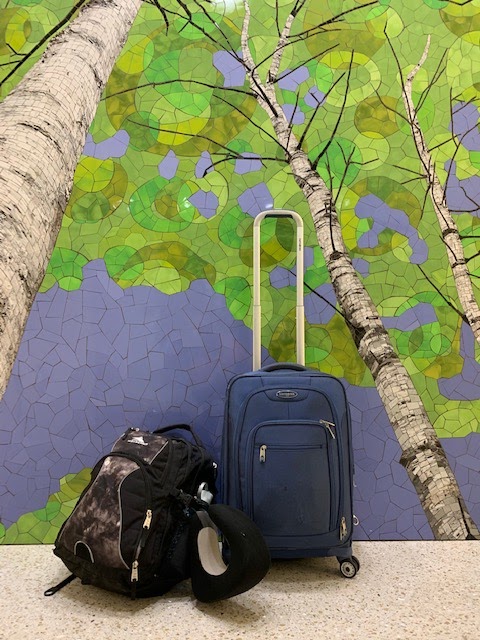
This was ALL of my luggage for the trip.  50% of my blue bag is "gifts" for our host school.  I will be SO happy to give those gifts for many reasons, one of which is just to have the extra space in my bag.   Also, yes, this picture was taken in the MSP airport bathrooms.  I 🥰 the MSP airport art. 


I woke up at 3AM on Saturday morning to get to the airport for a 5:00 flight to Houston.  Then from Houston we all met in Tokyo and then got into Jakarta at 11:55pm Sunday night.  Doing the math... we the trip to Houston was 3 hours, I had a 2 hour layover there, Houston to Tokyo was 13 hours, had a 5 hour layover there, plus another 8 to Jakarta... soooooo... 31 hours travel time.  I spent most of the airtime asleep or watching movies - but mostly asleep. I am so thankful I am able to sleep on airplanes!

This is from the Tokyo airport.  Two of my fellow fellows made a block print in this free culture exhibit.  We were wondering, what would be the US equivalent to this?  Something that people could do (maybe even take home with them) that demonstrates the US history and culture?  Got ideas?!  Share them with me!

This is part of the group waiting in Tokyo.  I tried to keep walking at stretching but while my luggage was condensed, it was also DENSE.  So walking around was not my fav. but I did a lot of stretching in place instead. 

I am a little nervous that I have watched all of the movies I want to see on the way there, I am hoping that airlines refresh their movies every month so when I fly back in August there will be some new options - I realize this it a absurd "problem" to have, but I would be lying if it weren't on my mind.  Airplane movies are the best - they are ones that you would never go pay to see, but you are still a little curious.  Sure, some are complete duds ("Isn't it romantic" was a major bust, BTW), but others will surprise you (Captain Marvel - I was a huge fan of, even on a tiny screen).  Which brings me to my million dollar idea of the day - connecting movie flights to Rotten Tomato scores on the screen - I need some help prioritizing all the B-list movies I am psuedo-interested in.

But I digress...

One of the things I was most worried about in Indonesia is the weather/clothing combo.  It is hot an humid and with it being a Muslim-majority country, it is pretty conservative.  We were told long sleeves and pants and lots of linen.  Let's just say that's not in my regular closet - especially after Marie Kondo convinced me to get rid of everything I never wear.  I spent much of my previous weekend going to Goodwills and Marshalls to see what I could find.  I ended up doing alright for myself, but I gotta say, wearing long pants in this heat and humidity makes me a bit queezy just thinking about it.  Hopefully my body will just adjust to the weather.  My roommate, who lived in Malaysia for a year, has yet to put in her AC in her room in MN and "loves" the heat and humidity there - she claims it is from her year in Malaysia.  We will see if I will be able to acclimate so quickly.

Since clothing has been on my mind, I spent a lot of time in the airport looking at what women were wearing.  It certainly is more conservative and there are a lot of head coverings, but there are dresses that are knee-length and some tanks and for sure some short sleeves.  I think Jakarta is going to be a little more OK with less coverage - unfortunately I didn't pack any knee-length things (maybe I will need to go shopping here).  I do know the school we are at is very conservative, so I am prepared for that - at least clothes-wise.  They don't have AC... so... that will be an adventure!

The hotel we are in right now is really nice.  I woke up this morning and looked out the window to see a "pool-side view".  I think "pool" isn't really the right word - it s a more of an Oasis outside! 


Once you get past the distraction of the pool this image might have a lot of other info.  There are some serious sky scrapers.  But also some really small "huts" or "shack" type places near our hotel too.  I am curious about that juxtaposition.  You can also see what looks like a mosque of some kind and to the far right you can see some garden or greenery on top of the roof.  The "Question Formulation Technique" training in me is on full blast - there are so many questions that could come from this one photo.  It is times like this that I wish I taught social studies because there are so many "social" questions in this photo.  I suppose you could make some math questions out of this too, but the social ones intrigue me more at the moment.

This morning I forced myself to wake up at 8 am to try to get into a routine a bit.  I went down for breakfast which was way more than I expected.  It is like a global breakfast - European, American, Asian - all sorts of options.  I ran into one of our guides at breakfast who encouraged me to try this juice.  I will find out more about what it is - I didn't have a notebook on me to write it down.  It supposedly was a very popular.  I think "juice" maybe wasn't the right word.  It had some kick to it - maybe it was cinnamon... I will get the name and google the recipe.  I had an omelette and fruit for breakfast.  The variety of other options was a bit overwhelming and we have 5 more days here, so I thought I would stick with the basics for day 1. 

Un-named juice.

After breakfast I hit the gym.  I know there are people out there right now saying, "WHAT!  You're in freaking Indonesia and you are going to the gym?!  GET. OUT. THERE."  Those hater's can stop reading here.   I do understand your perspective but a bit of gym time is just good for my soul.  It is a bit of "me" time that I need on a vacation - especially a vacation with a group of people like this.  

The gym itself was pretty good for a hotel gym in general.  I think gyms are a pretty US thing (I don't know what makes me think this... and if you know more about this, I'd love to hear about it), but this gym had a lot of cardio equipment and free weights.  My favorite thing about using weights in non-US countries is the fact that everything is in Kilos.  So while I used to do a dumbell bench press with 35lbs, now I just have to try different weights until I find some that "feel" right. 

Some of the free weights. 

That's all for day .5 of my blog.  I am hoping to spend 30 minutes blogging each day while I am here as a meditative/reflective practice, but I anticipate the future ones will be a list of bulleted wanderings/wonderings and not quite as comprehensive, but I also have started plenty of blog posts in the past that have started as "10 minute" reflections and lead to a weekend of adding to, refining, and re-thinking.  I am hoping to "just press 'Publish'" while here though.


Wednesday, January 30, 2019

Being the "lower performing" student

I don't know what your school calls "it" but I think every school has some sort of euphemism for it.  Most of them are all well intentioned.  That's not what this post is about though.

I will be honest, I have never been in that category as a student.  Never.

Thus, when I enrolled in a second masters degree program and I was conditionally accepted as long as I got a B in my first two classes, I thought, "Meh, easy! I haven't gotten below an A- in a class since... maybe ever."

I think I have worked hard in school, but I also had very few barriers to my success.  I was not diagnosed with a disability.  I grew up with English as my native language.  I always had a bed to sleep in and food to eat.  At the time that seemed normal, but I know that really made me pretty privileged.

Thus when I was working on my first grad assignment for this program after school on a Friday from 3:30-11:30 PM, AND not really experiencing any success, I was thrown off a bit.  Yes, I had perhaps waited until the last second to do it (it was due at midnight on Friday), but I surely thought 8 hours would be enough time for a first assignment.

I turned in something.  I knew it wasn't correct.  But it was SOMETHING.  I know how to play school and turning in something is better than turning in nothing.

The next morning at 8AM the next assignment was released.  It wasn't looking any more promising.  Again, I think I didn't understand 1 out of 10 of the words in the assignment prompt.  Generally, that's not a good sign.

Nevertheless, fast forward another 6.5 days and I still found myself on a Friday night at nearly midnight after a week of teaching submitting work that was not great, to the instructors.

This pattern continued each week.  I was given very little timely feedback so I had no idea how I was doing in the course, but my gut told me it wasn't good.

At one point we had a group project where I was paired with 3 other people: one person working on his PhD in computer science, one from industry, and another grad student at the school who majored in CS.  I was relieved to have other humans to talk to but also felt very out of place.  I was the only female in the group.  I was also the only person of my ethnicity in the group.  I was also the only person who had no (or very little) formal education in computer science. 

Normally, I am the "take charge" person in the group.  Sometimes, to a fault.  I would rather see things get done well than hope that someone else follows through.  But, here, in this group, that was not happening.  I started the meeting, I took notes, I helped construct the agenda, I asked questions, I proof-read documents we were turning in, but I did very little (read: "none") of the programming.   The night before our project was due (8 AM on a Saturday), my group was working on it.  I had finished all the proofreading; programming was the only thing that needed to be done and I had no idea how to contribute.   It was near 1:00 AM when I told the group, I was tapping out.  I told them I was going to bed but if they need me to proof read or update the documents, to let me know.

It felt gross.

I wanted to help the team but I couldn't.  I did not have the skills I needed to help.  It was just laughable to think about how I would help them.  In my mind, the most likely result would be that I would mess up some section of the task unknowingly when trying to help.  They were up until 6AM working on the task.  I know they were up that late because I woke up at every group text message between the remaining members.

The rest of the course followed the same progression of "Panic! Do your best. Submit with fingers crossed. Repeat."  Feedback was so delayed that I had no idea how close I was to the "B" that I needed to continue.  I wasn't sure if I wanted to continue.  AND, if I wasn't close to that B, I didn't want to spend any more hours on a Friday stressing out about a task.

It wasn't until 2 weeks past the end of the semester that I got my final grade.  It was a B.

That B says that I learned what agile development is and how to make a UML diagram from requirements gathered from a user, but those things weren't the most important take-aways for me.  Here is what I REALLY learned:

  1. It is not any fun being the "lower performing" student.
Ok, there are some sub-lessons-learned from that, including:
  1. Soft skills enable hard skills.  When I didn't know 10% of the words in an assignment, I knew how to google them.  I believed I could chip away at it.  I knew if I could figure out this one sentence, that would allow me to do one part of the task I was assigned.  I have pretty high self-efficacy, which allowed me to be as successful as I was.  But again, I never was that low performer.  Had a run into things I didn't know how to do before, of course, but was it this frequent, never.  Those small stumbling blocks I had occasionally faced in my past enabled me to keep going in this course.  What I don't know is how to get students to be able to have this persistence.  I had to deal with this reality for one semester.  Imagine that being your reality for 10 years of schooling.   I don't think I would be interested in picking up a pencil during math class either.  Why bother.  I am not advocating for lowering the bar for students but we cannot keep hitting kids with the bar - that's abuse.  
  2. It might not be that the low performer doesn't care, it is just that they don't know what to do.  I think as teachers we have all had those students who just don't really do their work in group work tasks.  They don't appear to do the cognitive mental lifting.  They may even seem actively disengaged or distracted.  In reality, they might not know what they can do.  This was certainly the case for me.  I wanted to help so much on a group task but it was not within my reach.  I did what I could but this still took a lot of initiative from me and also a belief that I could participate in an effective way.  I have had a few heart-to-heart conversations with students to get them to participate but to be honest, I don't give them concrete things to do often enough.  I also am not sure if I am ok with them participating in superficial ways like I did.  We want them to be integral to the team, but if a student is far behind, then what?  I think as a teacher I can be more concrete with my expectations and be more thoughtful about how each student participates.
  3. Broadening the definition of "smart" still falls short of being inclusive.  In Knowles and with Jo Boaler we talked about assigning competence as a way to increase equitable teaching practice and access to the content.  The idea is that if we think of being "smart" as just getting the answer quickly, we are not allowing students multiple ways to show their "smarts" - we need to recognize the more subtle ways of being "smart" in a classroom.  That happened once in my group where we choose one person's diagram to tweak and the group choose mine.  It did feel pretty good when they choose mine, but that was probably the highlight of my contributions.  Thinking about it, if someone told me, "The way you documented our meeting in those notes really helped our group stay on task" or "That's a great question, that makes me think XX..."  that may have helped feel better about the course - had that come from the instructor, I probably would have felt really great!  But I still didn't have success with the core content.  I know CS (like math) is more than just programming, and I would still rather have strong soft skills than strong hard skills, but I was there to learn the hard skills and I don't think that happened. Connecting to the classroom, I think this is rough to change.  Recognizing "smarts" in multiple ways is a short-term fix.  Long term, the fix is more complicated. 
  4. Support networks.  Yeah, they matter.  I joked with my sister that I should have been dating a computer science guy this semester - we would have had a lot of quality time together.  It is true, I would have learned a lot more with a trusted friend/mentor to help me.  The instructor was unavailable to the extent I needed them.  At one point, I could not figure out why the software wouldn't let me "run" a program.  Literally the "run" button was grayed out - I couldn't click it!  I googled it and tried 100 different things.  I then called a friend's boyfriend who worked in industry.  I went to his house and he was able to fix it.  It took him 5 minutes.  It took me at least 2 hours of research and I was still unsuccessful.   There were several times where I found myself banging my head against a wall for too long before calling this friend to have him fix it.  These weren't even content related really, just things I didn't know how to do yet.  Our students come with a variety of support networks and it influences what they are able to do on a daily basis outside of class. 
Overall, I am glad I took the course.  It was certainly an empathy builder.  I also learned things I can bring back to my classroom content wise, but I think the real sticking points were these last four.  In some ways, being the lower performer is tougher psychologically and intellectually.  Having empathy is a great place to start, but not a great place to stay.  These take-aways have given me some good next steps, but there is still a lot I am unsure about.

Finally, for the record, I took a semester off from the grad program now.  I am hoping to re-join in the summer or next fall.  


Sunday, November 25, 2018

Feedback from CSA students

Last week I had Aaron Willford do a "Learner Perspective" activity with my CSA students.  You can find the process here.

I have done this with some subgroup of my students every year since Aaron has offered it.  I choose my CSA students this year because it was my second year teaching the course, I had made changes and I still have some changes I want to make, but I was interested in getting student thoughts.

He broke the results down by hour.


Last year a different person did in my classroom and they were like "here are your results" with nothing afterwards.  I realized I needed to talk through it with someone.  Thankfully Aaron was a captive thought partner.

One of the first things he said was how he felt a big difference between my two sections of CSA.  I, too, have struggled with this.  One hour used to be 36 kids big (now just 30) and the other one is 20.  Aaron even mentioned that the first section seemed almost combative whereas the second one seemed more friendly.  I am glad I am not the only one with this perspective.  I have said this before, but class size does matter.  Having 20 kids allows me to teach and be more responsive in a way I cannot be in my class of 30. 

Another perspective Aaron had was that he only pays attention to the perspectives that had more than 50% of agreement.  I appreciate that to an extent.  BUT if we are to help ALL kids learn, even if 1 kid has an opinion that maybe is an outlier, that can still be considered.  I suppose it makes sense to focus on how can I change my instruction to impact the most students.

This year, I had a lot of "I wonder what the heck they mean by XX" moments.  Aaron could provide some perspective on that based on his conversations with students.  He also recommended I talk to students to get more perspective.  I think that is a good idea in a very structured manner.

Here were some of my biggest surprises and thoughts:

  • Students in my 5th hour like to work together, but don't like pair programming.  That is confusing to me.  We actually haven't done pair programming for a while, but we should do it again soon.  I think I need to be more clear on what the expectations are for pair programming.  A few Twitter peeps have made a rubric for pair programming that I am going to start to use.
  • 6th hour mentioned the "examples" as being helpful.  When ever my 5th hour struggles a lot, I adjust and do more hand holding with 6th hour.  We might do something together or do a "code-along" or something like that.  I probably need to do that more with my 5th hour too.  I just need to have more extensions for advanced students in my 5th hour.
  • Students like test reviews.  I think this goes back to a culture, especially around "AP students" that they think doing a review is a "short cut" to learning the material.   As long as they are still working in class throughout the entire unit, I am ok with giving a review.
  • Grading more things.  This came up in both classes.  I think this group is reluctant to do things unless they get a grade for it.  Aaron suggested to have students reflect on their learning for the things I don't collect, and then put their own self-reflection grade in a no-count grade in the gradebook.  I contend that students just get crabby if I don't collect things.  They feel like "why did I do this, if I am not going to get graded on it".  I need to coach them out of that mindset.  For the time being, I think I can do a better job of just collecting more programming tasks.


What's next?  Well here are some changes I can make immediately:
  • I think I need to have students reflect on pair programming - I can use Dan's rubric and Aarons google form to collect this reflection.  In general, I think I need to build in more reflection time in general in the class.  One way we can do that is to read this article and use a protocol to have students think through their role in the class.
  • I would like to get a bit more meta. I want students to be able to articulate when they are learning.  How they know they are learning.  I have answers to these questions, but I think student's might see some of the class time as being "wasted" because they are spinning their wheels (or for other students, copying and pasting code).  They need to be able to think about their own learning. 
  • Talk about what "effective" class time looks like.  I want students to decide what it means to use our class time effectively.  I want to come to an agreement as to what I need to do as the teacher to make effective use of our class time and what they need to do as students to make effective use of the class time.  I think it is also important to be transparent that while they have ideas about learning, which may be valid, at times I will need to pull rank as the expert in learning in the room. 

Ending note: I was talking/tweeting with The Dan Schneider and was lamenting how I have not done enough writing/reflecting this year.  In the spirit of #MTBoS, I decided to #justPostIt and forget about the little details of refining this post.  I started writing this 4 days ago, and now as I am planning my next week, it is time to just post it.

Thursday, August 30, 2018

What I am thinking about this year

One of my Code.org co-facilitators asked me this summer, "What are you focusing on this year?", with it being mid-summer I was kind of caught off guard, the school year seemed so far away, but now with the time approaching, I've taken some time to think about the areas I am most jazzed about improving my practice this year.

  1. Increase belonging in my classroom.  I think along with this is to think more intentionally about who participates in my classroom and how do they participate with a special focus on under-represented populations.  
    1. Levers to pull in this area:
      • Highlighting student work and thinking - for highlighting student work, I am thinking of displaying creations in the hall or in technologies outside the classroom.  I also can do a better job of showing student thinking in class.  I pull a lot of ideas from the room, but I want to be more careful on who's voices I amplify in that process. 
      • Question of the day - I stumbled upon this deck of questions for students in an advisory class, but I think they could be used in any class to allow students to do some introspection as well as have all-class conversations about topics around identity.
      • Provide. Student. Choice. - I need to think about when I can provide students more choices and then do that.  THEN highlighting the different choices students make in a public (validating) way that assigns competence to each student can help students feel a sense of belonging.
      • Learn more about introverts - I am currently reading the book Quiet: The Power of Introverts in a World That Cannot Stop Talking.  It has opened my eyes into how much society (and myself) values extroversion over introversion and how we are leaving some fantastic minds un-tapped in that process.  I used to think my goal was to help introverts "become" extroverts, but I need to re-examine that.  I am not done with the book, but I know I need to do a bit more thinking about this.
      • Check in with students daily - I think my best year of "connectedness" with students was my first year when I "checked in" student homework by going around the room each day to check it.  It allowed me to say hi to each student and also make a little bit of small talk.  I already meet students at the door each day but sometimes it gets a little backed up and some students take advantage of that time more than others. 
      • Talking Points - At a TwitterMathCamp I saw someone demonstrate using "Talking Points" in their math classroom to talk about doing mathematics.  I am wondering if doing something similar in CS about issues of representation in CS classes and industry would help bring awareness to the class about this issue.  I could also see doing this for other topics as well - I think in general adding more structure to classroom conversations can help support all students in having equal voice in discussions.
      • Seating charts - Oh seating charts... when teaching math I used to do intentional grouping in heterogenous groups.  When I switched to CS I let students sit where they wanted.  The result was that students got to know less new people.  I also think this lead to some people feeling isolated if they didn't have friends in the class.  This year I am going to do random seating charts every twp weeks.  I think this will allow students to get to know new people but also make it sustainable for me.  I will still allow people to pick partners for group PROJECTS but not for daily work.
    2. Data to gather:
      • Survey data - This is a little tricky since I feel like asking students "do you feel like you belong here" is a bit off-putting or might lead to inauthentic results.  I also think the term "belonging" needs to be unpacked a bit.  What I want my classroom to feel like is a giant family.  I have had classes that have really gelled like that and it is an awesome feeling.  
      • Focus groups - UGH this is a dream of mine.  I would love to get some of my girls together from CS classes and hear their thoughts on belonging in the CS classroom.  Do they feel "othered" in the room?  What deminishes that feeling and what amplifies that feeling?  I would also like to do that of students of color too.  I have no idea of this is logistically possible, but something to look into.
      • Student reflections - I am wondering if I could have a day (or part of a day) where we talk about places or communities that they feel like they "belong" in.  It might be that it is when they are with family, or with friends, maybe it is when they are online playing video games, maybe it is when they are in the art studio... I don't know, but I wonder if we can pull out those qualities into the classroom. 
      • Student participation - I think there are various ways to measure student participation, all of which I want to explore.  I am making an assumption that when students participate, they feel like they belong. 
  2. Increasing collaboration and creativity in programming.  
    1. Levers to pull:
      • Consider where, how and when to involve more project based learning into my courses - Initially I was thinking of calling this more "Project Based Learning", but really my goal in doing more project based learning is to get at this collaboration and creativity piece.  I don't see PBL being the only way to accomplish this.  In both CSA and CSP this year I want to give some more open projects to students.  Whenever I did that last year, engagement went up and I saw students creativity shine through a bit more.
      • Provide. Student. Choice. - Sounds familiar, I know, but it seems to fit here too.
      • Raise the ceiling - Provide tasks and projects that allow students to really go ALL out.  This will reduce the "I'm done" effect some students have. 
      • Pair Programming! - I am doing it this year with fidelity.  It will increase collaboration, but I am not sure about creativity.
    2. Data to gather:
      • Reflections - Mainly my own.  I need to think more deeply around a few key questions: How do I know if students were creative?  What does "being creative" look like?  Are there multiple ways to "collaborate"?  Is all "collaboration" verbal?  Who benefits when I value collaboration and creativity?  Who is left out?  What supports can help students collaborate and be creative?  Can I "teach" creativity in isolation?  Should I?  Clearly, I have a lot of questions that still need to be answered here.
      • Surveys - Man I love a good survey.  It allows me to hear from all students equally.  In past surveys, students always rank the Unit 3 - Design a Digital Scene as their favorite task.  It is crazy.  It is through this data I am assuming students thrive in collaborative and creative environments. 
      • Data from Tasks - I am thinking back to Knowles in how we would look at an assignment and consider what "unspoken" values are being communicated in a task.  I wonder how tasks I provide students with portray the role of collaboration and creativity.